Beyond Dry January: Why 49% of Americans Are Drinking Less and What Beverage Brands Should Do About It
Your customers aren't just giving up alcohol for January. Nearly half of them are giving it up for good.
According to NCSolutions' 2025 consumer survey, 49% of Americans, a 44% increase compared to 2023, plan to reduce their alcohol intake year-round. In 2025, 54% of U.S. adults said they believe drinking alcohol is bad for their health, while 30% took part in Dry January.
Gallup reports that alcohol use has hit its lowest level since 1939. Wellness awareness has intensified, workplace culture favors productivity over late-night consumption, and social rituals are diversifying beyond alcohol-centered occasions. And, a new class of GLP-1 drugs, now used by millions, is suppressing the neurological reward of drinking at a biological level, accelerating what was already a structural shift.
This isn't a Dry January hangover. It's a categorical reshaping of how Americans socialize, relax and consume. Consumers aren't abandoning adult beverages — they're demanding different ones.
For brand leaders, this isn't a trend to watch — it's a signal to act. The question is no longer whether consumers are drinking less, but what they're reaching for instead, and whether your portfolio is there when they do.
3 Consumer Segments Driving the Alcohol Consumption Decline
Alcohol moderation isn't monolithic. Behind the headline numbers are three distinct consumer groups, each cutting back for different reasons and each requiring a fundamentally different product response.
The Total Abstainers
Total abstainers adopt a fully dry lifestyle. This group includes wellness-focused consumers, pregnant women and individuals in recovery. They want to see 0.0% ABV certification and often scrutinize labels, expecting transparent ingredient disclosures.
In 2025, 0.0% ABV beer sales grew at a faster rate than broader nonalcoholic (NA) beer sales. Retailers are allocating incremental shelf space to 0.0% certified products, evidence that the distinction matters for brand positioning. For consumers in recovery, even trace alcohol content is unacceptable.
For total abstainers, a "dry" lifestyle is a nonnegotiable commitment. This group includes wellness-focused consumers, pregnant women and individuals in recovery, for whom even trace alcohol content is unacceptable. They scrutinize labels closely and expect 0.0% ABV certification and full ingredient transparency as baseline requirements, not differentiators.
The market is responding. In 2025, 0.0% ABV beer sales grew faster than the broader NA beer category, and retailers are allocating incremental shelf space specifically to 0.0% certified products. The certification distinction that once felt like fine print is now a purchase driver, evidence that the distinction matters for brand positioning.
Meeting this segment's expectations is technically demanding. Ethanol does significant sensory work: it affects aroma volatility, mouthfeel and flavor perception. Removing it fundamentally alters a beverage's profile. Brands formulating for Total Abstainers must engineer:
- Aroma systems that replicate the ethanol lift without alcohol.
- Structured mouthfeel using glycerin, fibers or hydrocolloids.
- Bitterness management to avoid thin or metallic finishes.
The Moderators
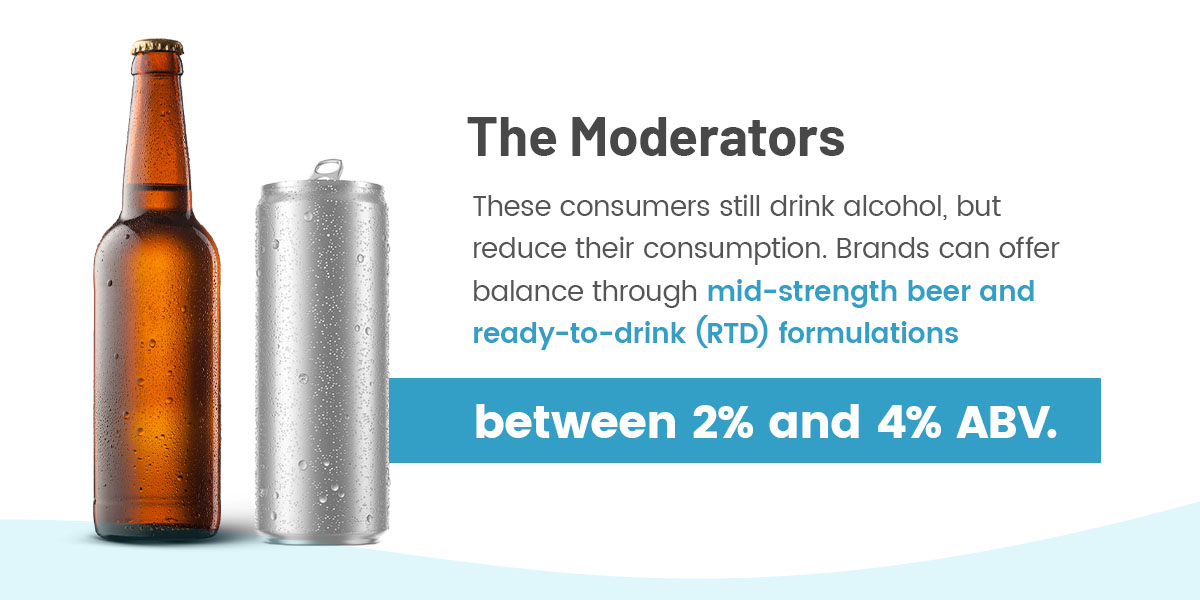
Moderators represent the largest commercial opportunity, as these consumers still drink alcohol, but reduce their consumption by alternating with adult NA options or choosing lower ABV products within a single occasion. They're focused on managing calories and pacing themselves while enjoying social experiences. Millennials and Gen X are trading one or two high-ABV beverages for alternatives with a light body and below-average alcohol percentage.
Flavor parity drives success. Moderators still want to experience beer's full flavor complexity. That means bitterness structure in NA IPAs, oak notes in NA wine and botanical intensity in zero-proof spirits. Commercialization should focus on:
- Authentic sensory profiles.
- Packaging that fits into existing alcohol occasions.
- Pricing strategies that align with premium cues.
Brands can offer balance through mid-strength beer and ready-to-drink (RTD) formulations between 2% and 4% ABV.
In short, Moderators aren’t stepping away from the occasion. They’re redefining how they participate in it. Nonalcoholic and low-ABV options sit alongside traditional alcoholic beverages, which means they need to deliver on both experience and perception.
The Functional Seekers
Functional seekers don't only want less alcohol — they also want a different outcome. Gen Z's relationship with alcohol is more nuanced than the headlines suggest. IWSR's Bevtrac data shows Gen Z participation in alcohol has actually risen since 2023 — but they're becoming sharply more selective, with the average number of drink categories consumed per occasion dropping from 2.8 to 1.8 in just two years. In fact, 23% say they're drinking NA beer, wine or spirits often. They're not abstaining; they're editing. That editing behavior is what's driving demand for functional alternatives — not as a replacement for alcohol, but as a deliberate choice for specific occasions and specific outcomes.
This segment is increasingly looking for stress relief in adaptogens or focus on nootropics instead of intoxication, viewing categories like NA, functional, energy and emerging alternatives, such as hemp THC, as one competitive set alongside conventional alcohol. Over one in four Americans plan to try THC-infused beverages, 38% of this group being Gen Z.
Functional seekers often research ingredients before they buy. Mood is the #1 benefit consumers are demanding in their beverages, with ingredients such as:
- Adaptogens like ashwagandha for stress support.
- Nootropics like L-theanine for focus.
- Mushrooms like lion's mane for cognitive claims.
- Hemp-derived cannabinoids for improved sleep and anxiety.
Formulating for this segment requires precision. Many functional ingredients introduce bitterness, astringency or earth notes. Lion's mane can leave a musty undertone, ashwagandha can create lingering bitterness and nootropics could have solubility or stability issues. To commercialize successfully, brands must:
- Mask off-notes through layered flavor systems.
- Adjust sweetness curves to offset bitterness without sugary finishes.
- Use texture modulation to build body in alcohol-free matrices.
- Validate stability over shelf life, especially in RTDs.
Premium RTDs are a primary vehicle. These formulations allow controlled dosing, convenience and clear positioning by supporting sparkling, still or nitro formats.
Texture matters. Adding soluble fibers or specific hydrocolloids can recreate viscosity. Carbonation levels must also align with the intended effect. Higher carbonation can enhance the perceived brightness and reduce bitterness in the beverage.
Why Are Americans Drinking Less Alcohol?
Americans’ relationship with alcohol is shifting, driven by a mix of cultural resets, health awareness and financial pragmatism. What was once a habitual part of social life is increasingly evaluated through the lens of well-being, identity and value. Three key forces are shaping this movement:
- Wellness and longevity: Consumers increasingly link alcohol to sleep disruption, inflammation and long-term health risk. Wearables and health tracking apps reinforce this awareness in the next generation of the wellness segment. Many go alcohol-free for a specific period, such as Dry January, then continue after experiencing tangible benefits.
- Social decoupling: Younger consumers are separating social connection from alcohol consumption. Instead of spending a night at the bar, younger Millennials and Gen Z are building relationships at coffee shops, fitness studios and other daytime gathering spaces. Public intoxication has also become a reputational risk in the age of social media.
- Economic rationalization: Many consumers, particularly Gen Z, are scrutinizing the cost-value of alcohol. According to Circana, one in five individuals says drinking alcohol is a habit they can no longer afford. As the cost of living rises, that pressure is only intensifying.
- Pharmaceutical modulation (GLP-1s): The rapid uptake of GLP-1 weight-management drugs is subtly reshaping consumption patterns. Early clinical and observational data suggest these medications can reduce alcohol cravings and intake by dampening reward pathways in the brain, adding a pharmacological layer to the moderation trend. According to EY-Parthenon's 2025 consumer survey, 44% of GLP-1 users report drinking less after starting treatment — and 82% maintain those habits even after stopping.
Consumers are drinking less overall, but when they do drink, they are increasingly treating it as an intentional indulgence, often trading up to premium RTDs, elevated NA spirits and functional beverages. Less often doesn't mean less spending. It means spending with greater intention.
Product Innovation Opportunities
The shift from seasonal abstinence in Dry January to year-round moderation creates clear formulation and commercialization pathways, with RTDs leading the change.
For brands, this isn’t about launching a single nonalcoholic SKU. It’s about building a portfolio that spans occasions, alcohol levels and consumer needs. RTDs are a key vehicle in this shift, offering scalability, controlled dosing and flexible positioning.
High-Fidelity Adult NA Alternatives
Many consumers expect adult NA beverage alternatives that are indistinguishable from alcoholic options. Shelf-space is growing for NA beer in particular, as 40% of industry professionals say craft NA beer has staying power. That same expectation is now extending into NA spirits and cocktails.
The main technical hurdles are mouthfeel, aroma and finish. To replicate the heat and structure of alcohol in NA spirits and cocktails, developers can:
- Use carbonation to carry aroma and thin the beverage.
- Add glycerin or specific fibers to enhance viscosity.
- Apply targeted spice to mimic the burn of alcohol without harshness.
Lower-ABV Sessionable Offerings
Mid-strength products align with moderation trends and observed polarization toward no-/low-alcohol, bridging conventional alcohol and adult NA portfolios. From a beer production standpoint, lower ABV follows careful fermentation control and flavor balancing.
Functional Ingredients Integration
Functional ingredients integration relies on technical discipline. Adaptogens and nootropics can introduce off-notes in beverages that need masking strategies, such as:
- Layered citrus and tropical profiles to distract from earthiness.
- Controlled sweetness using non-nutritive sweeteners with clean finishes.
- Texture systems that prevent thin, watery impressions.
Consider lion's mane in a sparkling RTD. Acid adjustment can balance earthy undertones, while carbonation helps lift brighter top notes — effectively pushing heavier, musty aromatics to the background and reducing their perceived intensity. With beverages containing several grams of mushrooms, though, you can't completely cover the mushroom notes.
Start Your Nonalcoholic or Low-ABV Commercialization Beverage With BevSource
The shift beyond Dry January is not a short-term disruption. It’s a long-term change in how consumers approach alcohol, occasions and wellness. Brands that win will be those that evolve their portfolios accordingly, whether that means expanding into nonalcoholic, developing lower-ABV options or integrating functional benefits.
Partner with BevSource to develop your adult NA or low-ABV beverage. Our team sources specialized ingredients, optimizes flavor systems and scales production to your brand's needs. Whether you're developing a new beverage in this category or preparing your brand to align with these beverage trends, we offer practical solutions that keep your momentum going.
Contact BevSource today to make your beverage viable and production-ready.