Purpose-Built Beverages: Why “Functional” Isn't Enough Anymore
The functional beverage category in the U.S. is on track to exceed $97 billion by 2033, growing at roughly 8% CAGR. Yet “functional” has shifted from a differentiator to a baseline expectation. Electrolytes, adaptogens and protein no longer command shelf space or premium pricing on their own. They're table stakes in a category where every beverage claims to support focus, immunity or gut health.
The brands winning in 2026 and beyond aren't building beverages around ingredients — they're building them around a specific occasion or targeted benefit. From concept, purpose-built beverage development owns a moment, mindset or outcome for a specific drinker — the pre-round clarity beverage, the 4 p.m. energy reset or the alcohol-free social aperitif.
What Are Purpose-Built Beverages?
A purpose-built beverage is formulated, positioned and packaged around a specific consumer moment, mindset or outcome. Every formulation decision from ingredient selection and dosage to flavor profile, format and claim language supports that singular purpose.
The difference between functional and purpose-built beverages isn't the ingredients. It's the starting point. Functional beverages add a benefit to an existing format; purpose-built beverages design the format around the benefit. The goal of a purpose-built beverage is to compete on consumer rituals, not ingredient lists.
Consider a pre-meeting clarity beverage formulated with L-theanine and lion's mane, packaged in a convenient single-serve format. The ingredients, dosage, flavor profile, package format and messaging are all designed to help professionals feel focused before an important meeting. That's purpose-built. On the other hand, a simple vitamin-fortified sparkling water is functional. It adds a benefit to an existing format.
Why Are Beverage Brands Moving Away From Functional Positioning?
Three forces are accelerating the shift from functional positioning to purpose-built beverages: changing consumer behavior, category saturation and evolving health priorities.
Consumers Are Drinking More Intentionally
The sober curious movement continues to reshape alcohol consumption patterns, with 49% of U.S. adults planning to drink less alcohol and 39% of Gen Z adopting a dry lifestyle in 2025. That spending hasn't disappeared. It's migrated to nonalcoholic alternatives, adaptogenic tonics and social beverages engineered for specific occasions.
Consumers who used to order a glass of wine at dinner now want a nonalcoholic option that delivers the same ritual and complexity, not just a sweetened seltzer. The occasion drives the purchase, not the ingredient deck. Brands that build around these distinct social and emotional moments are well-positioned to capture that shift.
The Functional Shelf Is Crowded
Today's grocery cooler is packed with functional claims that blur together, including energy, focus, immunity, gut health and hydration. These claims are so common that 47% of U.S. adults feel overwhelmed by the assortment of functional beverages. When every brand makes the same promise, none of them wins.
Purpose-built beverages cut through by narrowing rather than broadening. They pick one consumer and one outcome, and own it. Breakout brands like Vibes Beverages in the social-mixer space and De Soi in the alcohol-alternative aperitif category demonstrate that focused positioning breaks through even in a saturated market. They succeed because they're competing in specific consumer rituals where functional beverages haven't staked a claim.
Health Priorities Have Matured
Consumers have moved past single-ingredient hype cycles. They're now looking for beverages that exhibit measurable, targeted benefits for specific needs:
- Protein and fiber for satiety: The protein and fiber shift has reshaped formulation priorities across the category, as brands target nutrient-dense positioning that delivers sustained energy and fullness rather than empty calories.
- Nootropics for cognitive performance: Ingredients like L-theanine, citicoline and lion's mane are moving from niche to mainstream as consumers seek to improve focus without jitters.
- Prebiotics for digestive wellness: Brands are moving beyond probiotics to include prebiotics and postbiotics, recognizing that digestive wellness claims require substantiation.
“Functional” alone no longer signals relevance. Purpose-built beverages align with these mature health priorities by tying specific benefits to specific moments and outcomes.
How to Position a Purpose-Built Beverage
Positioning is where most functional brands stumble. They lead with ingredients and hope the consumer translates that into an occasion. Purpose-built beverages flip the order. Here's how to stand out in the functional beverage market with a purpose-built brand:
Start With the Drinking Occasion, Not the Ingredient Deck
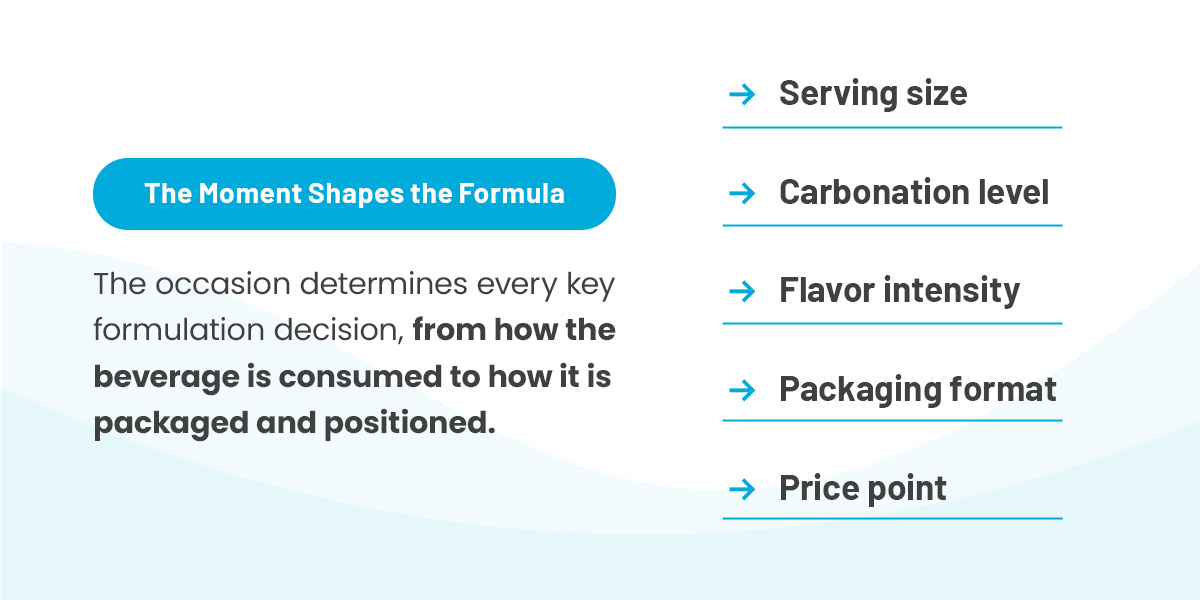
Define the moment before you determine the formulation. Is this the beverage for the 6 a.m. pre-workout, the post-school-pickup wind-down or the Thursday-night dinner-party pour? The occasion dictates everything downstream, including:
- Serving size
- Carbonation level
- Flavor intensity
- Packaging format
- Price point
Formulation decisions should be strategic rather than opportunistic. Rather than asking which functional ingredients to add, start by asking how you want the consumer to feel in the moment, then determine the best way to deliver the outcome.
Build a Sensory Profile That Matches the Mindset
Your beverage must create a targeted sensory experience for the consumer. A focus beverage should taste sharp, clean and slightly bitter to reinforce alertness and mental clarity. Think bright citrus, green tea and a hint of botanical aromatics. In comparison, a wind-down beverage should feel soft, rounded and slightly sweet to reinforce relaxation.
Off-notes need to be engineered out during formulation, not masked with a sweetener afterward. Sensory issues like the chalky finish of certain proteins, the earthy bitterness of mushroom extracts or the metallic edge of some adaptogens undermine the outcome you're trying to achieve.
Write Claim Language That Sells the Outcome
Instead of an ingredient parade, lead with what the beverage does for the drinker in their moment. Think of “clarity in a can” as the positioning concept, translated on-pack into compliant language such as “supports focus” or “promotes mental clarity.” The front panel communicates the occasion and outcome. The back panel explains how the beverage delivers on that promise.
This approach doesn't mean avoiding substantiation. Claims must still be defensible and compliant, but the hierarchy shifts. Consumers connect with the intended outcome first, then look to the ingredient stack to validate the promise.
Frequently Asked Questions About Purpose-Built Beverages
Here are answers to the most common questions businesses have when evaluating the purpose-built model.
Can I reposition my existing functional beverage as purpose-built?
In many cases, yes — and it's often faster than launching a new SKU. If your formulation already delivers a specific, measurable outcome, repositioning may only require packaging and claim language updates. The key is narrowing your messaging to own one moment rather than appealing to broad wellness. Brands that reposition successfully pick their strongest use case and build all communication around it.
Who's the Target Consumer for Purpose-Built Beverages?
The target consumer for a purpose-built beverage is a specific consumer you can name in one sentence. Instead of vague demographics like “health-conscious millennials” or “active adults,” use distinct behaviors and needs to define the individual. It could be the sales professional who needs focus without coffee jitters at 2 p.m., the parent who wants a sophisticated nonalcoholic option for backyard dinners, or the athlete who needs rapid rehydration after high-intensity training.
Are Purpose-Built Beverages More Expensive to Develop?
Not inherently. Ingredient selection and claim substantiation drive cost, not the purpose-built framework itself. Defining the occasion up front typically means spending less on reformulation and rebranding later. Up-front strategic consumer research, occasion mapping and sensory testing can shorten development cycles and strengthen product–market fit, which can offset development costs.
Develop a Purpose-Built Beverage With BevSource
Functional is the floor, and purpose-built is the ceiling. The brands that own a specific moment in a consumer's day command premium pricing and repeat purchase in a saturated category.
BevSource helps businesses develop products with purpose from day one. We provide concept validation, ingredient sourcing, commercial formulation, pilot production, and co-packer identification, all under one roof. Our team brings 20+ years of beverage expertise and an unmatched network of suppliers and co-packers to move your product from occasion-driven concept to shelf-ready reality.
Contact us today to begin building a beverage that wins on purpose.